Boundary Lines and Legal Mines: Resolving UK Neighbour Disputes Before They Destroy Property Values

The Hidden Cost of Neighbourly Wars
Property disputes between neighbours represent one of Britain's most common sources of civil litigation, yet most conflicts could be resolved through proper understanding of legal frameworks and proportionate responses. The Law Society estimates that boundary disputes alone cost UK property owners millions annually in legal fees, whilst unresolved conflicts can reduce property values by up to 10% when disclosure requirements force sellers to reveal ongoing disputes to potential buyers.
The challenge lies not in the complexity of property law, but in the emotional intensity that transforms minor disagreements into prolonged feuds. When neighbours feel their property rights are threatened, rational decision-making often gives way to pride and principle, creating expensive battles over issues that could be resolved through structured dialogue and legal clarity.
Boundary Disputes: Where Property Lines Become Battle Lines
Boundary disagreements frequently originate from outdated or imprecise property deeds that fail to clearly define where one property ends and another begins. Victorian-era documents often reference long-demolished landmarks or use measurements that don't align with modern surveying techniques, creating ambiguity that can persist for decades until development or renovation brings the issue to a head.
Before engaging solicitors or surveyors, examine your property deeds carefully alongside your neighbour's documentation if they're willing to share. Many apparent boundary disputes dissolve when both parties review the same historical documents and realise their assumptions were incorrect. The Land Registry's title plans provide official boundaries, but these are typically indicative rather than definitive for older properties.
 Photo: Land Registry, via landregistry-deeds.co.uk
When documentary evidence proves insufficient, commissioning a joint boundary survey often provides the most cost-effective resolution. Sharing surveyor costs between neighbours demonstrates good faith whilst ensuring both parties receive identical technical information. However, if your neighbour refuses to participate in joint investigations, you may need to proceed independently whilst documenting your attempts at cooperation for potential future legal proceedings.
The Leylandii Problem: When Hedges Become Weapons
High hedges, particularly fast-growing leylandii, represent Britain's most common source of neighbour complaints after noise issues. The Anti-Social Behaviour Act 2003 provides specific remedies for hedge disputes, but only after informal resolution attempts have failed and specific criteria are met.
 Photo: Anti-Social Behaviour Act 2003, via upload.wikimedia.org
Local councils can intervene when hedges exceed two metres in height and significantly affect the reasonable enjoyment of neighbouring properties. However, councils charge fees for investigating hedge complaints (typically £400-600), and they won't act unless you can demonstrate genuine attempts to resolve the matter directly with your neighbour.
Documenting your communications becomes crucial if council intervention becomes necessary. Keep records of:
- Written requests for hedge trimming with reasonable timescales
- Photographic evidence showing the hedge's impact on your property
- Any responses or lack thereof from your neighbour
- Evidence of how the hedge affects light, outlook, or reasonable property enjoyment
Councils possess powers to order hedge reduction and can ultimately arrange trimming at the hedge owner's expense if compliance orders are ignored. However, this process typically takes months, making early dialogue the most practical approach for resolving hedge disputes.
Party Wall Act: Construction Rights and Neighbour Obligations
The Party Wall etc. Act 1996 governs construction work affecting shared walls, boundaries, or nearby structures in England and Wales. This legislation requires property owners to serve formal notices on neighbours before commencing certain types of building work, creating a structured framework for managing construction disputes before they arise.
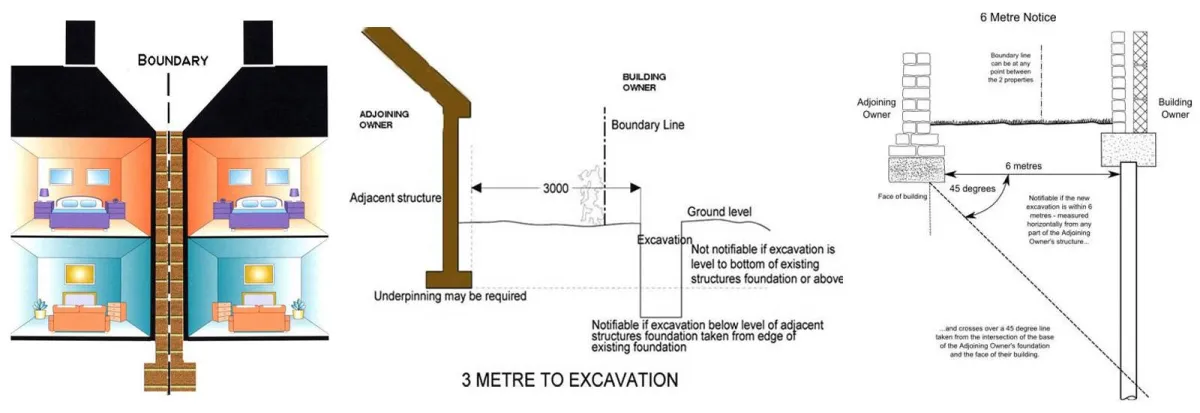 Photo: Party Wall etc. Act 1996, via www.jmsurveyors.com
Work requiring party wall notices includes:
- Alterations to walls shared with neighbours
- Construction within three or six metres of neighbouring buildings (depending on excavation depth)
- New walls built on or astride boundary lines
- Repairs or modifications to existing party walls
Serving party wall notices isn't optional when the Act applies—it's a legal requirement that can't be waived even if neighbours consent to the work. The notice period (typically one or two months depending on work type) allows neighbours to raise concerns or appoint party wall surveyors to protect their interests during construction.
Many property owners discover party wall obligations only when neighbours complain about unauthorised work. Retrospective compliance is possible but often more expensive and time-consuming than following proper procedures from the outset. Building control departments and structural engineers can advise whether planned work triggers party wall requirements before you commit to construction timelines.
Noise Nuisance: Balancing Rights and Reasonable Enjoyment
Noise complaints require careful documentation to distinguish between occasional disturbance and genuine nuisance that affects reasonable property enjoyment. Local councils investigate noise complaints under environmental health legislation, but they need evidence demonstrating persistent problems rather than isolated incidents.
Effective noise complaint documentation includes:
- Diary entries recording noise incidents with dates, times, and durations
- Audio recordings where possible (though legal admissibility varies)
- Witness statements from other affected neighbours
- Evidence showing attempts to resolve matters informally
Statutory nuisance investigations can result in abatement notices requiring noise reduction, but enforcement depends on council resources and the strength of evidence provided. Commercial noise monitoring equipment can provide objective measurements, but this expense is typically only justified for severe, ongoing problems that resist other resolution methods.
Some noise issues fall outside statutory nuisance frameworks, particularly those involving children playing or normal domestic activities during reasonable hours. Understanding these limitations helps set realistic expectations about potential remedies whilst focusing attention on genuinely actionable problems.
Mediation: The Underused Middle Ground
Neighbour mediation services operate throughout the UK, offering structured dialogue opportunities that cost significantly less than legal proceedings whilst preserving ongoing relationships between adjacent property owners. Professional mediators help parties identify underlying concerns, explore mutually acceptable solutions, and document agreements that prevent future misunderstandings.
Mediation works particularly well for disputes involving:
- Shared responsibility for boundary maintenance
- Access rights across neighbouring property
- Impact of home improvements on adjacent properties
- Pet-related complaints
- Garden and parking arrangements
Many insurance policies include legal expenses cover that funds mediation services, making this option financially accessible even when relationships have deteriorated significantly. The voluntary nature of mediation means both parties must agree to participate, but success rates typically exceed 80% when both neighbours engage constructively with the process.
Legal Action: The Nuclear Option
Court proceedings should represent the final resort after other resolution methods have failed, not because legal remedies are ineffective, but because litigation costs often exceed the underlying dispute's value whilst creating permanent animosity between neighbours.
Before initiating legal action:
- Obtain detailed cost estimates from solicitors
- Consider whether potential remedies justify the expense and stress
- Evaluate how prolonged disputes might affect property values
- Assess the strength of your evidence and legal position
- Explore whether your buildings insurance includes legal expenses cover
Small claims procedures handle some neighbour disputes involving damages under £10,000, but complex property law issues typically require county court proceedings with correspondingly higher costs and risks. Alternative dispute resolution clauses in court procedures may still require mediation attempts even after legal proceedings commence.
Protecting Future Property Sales
Unresolved neighbour disputes can complicate property sales through disclosure requirements that force sellers to reveal ongoing conflicts to potential buyers. Property information forms specifically ask about disputes with neighbours, and solicitors advise clients to err on the side of disclosure rather than risk post-completion claims.
Maintaining detailed records of dispute resolution efforts demonstrates responsible property ownership whilst providing evidence that issues were addressed appropriately. Even unsuccessful mediation attempts show prospective buyers that you attempted reasonable solutions rather than allowing conflicts to fester.
When purchasing property, investigating potential neighbour disputes through careful questioning and observation can prevent inheriting someone else's problems. Speaking with multiple neighbours, observing boundary conditions, and reviewing planning application histories provides insight into local dynamics that might affect your future enjoyment of the property.
Building Bridges, Not Walls
Successful neighbour dispute resolution requires balancing firm protection of property rights with recognition that ongoing relationships matter more than winning individual battles. The most effective approach combines clear understanding of legal frameworks with proportionate responses that escalate gradually rather than immediately resorting to formal procedures.
Remember that today's neighbour dispute opponent might become tomorrow's property sale witness or emergency contact. Maintaining civility throughout disagreements, even when legal action becomes necessary, protects both immediate interests and long-term property value whilst preserving the possibility of future cooperation.